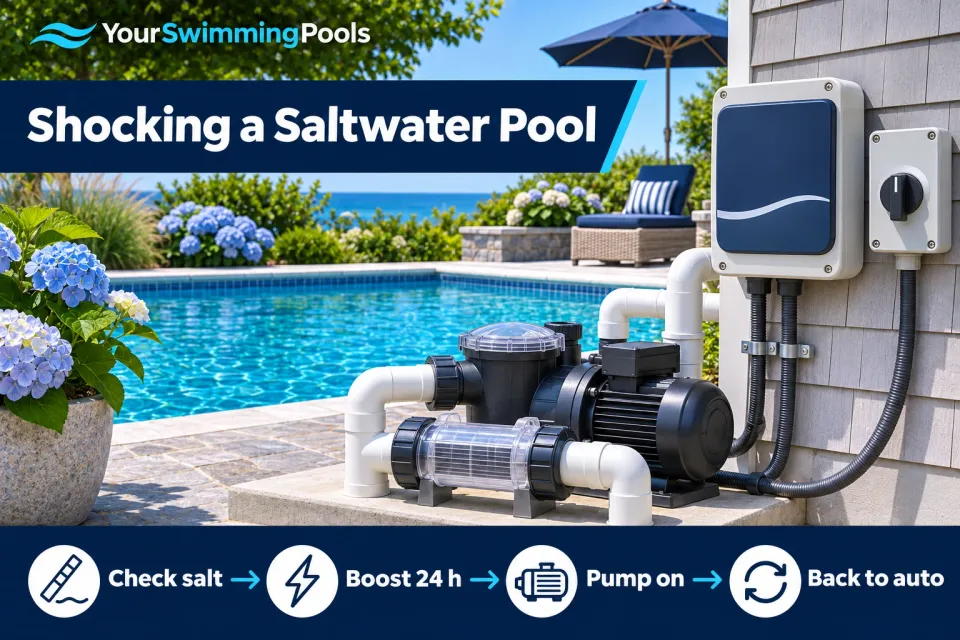
A salt pool already makes its own chlorine. So "shocking" a salt pool can mean two things: asking the cell for more, or adding chlorine by hand. Your manual decides which.
The short version: on a Hayward AquaRite, the SUPER CHLORINATE setting "super chlorinates" (shocks) the water for 24 hours, with the filter pump on, for a high bather load, a lot of rain or cloudy water. When the cell cannot keep up, for example after an algae treatment, the manual says to shock the pool by hand if the treatment's directions call for it.
Part of: Pool Shock: Types, Timing and Safety, our overview of pool shock.
As an Amazon Associate we earn from qualifying purchases. We have not tested these products.
Test kit Salt test stripsAn independent salt reading to check against your salt system display, as Hayward's troubleshooting document advises.
What the boost mode does (Hayward AquaRite)
- When: "an abnormally high bather load, a large amount of rain, a cloudy water condition, or any other condition which needs a large amount of purification".
- How long: the manual says 24 hours (the filter pump must be on) or until the power is turned off, whichever comes first. Hayward's troubleshooting document: 100% output for 24 hours, assuming the pump runs that long.
- After: put the switch back to AUTO.
- Cold water is a different case. The unit stops making chlorine below 50 °F. Switching to SUPER CHLORINATE overrides that cutoff, and the manual's troubleshooting section says the unit then runs at maximum output for the remainder of the current pump cycle or 24 hours, whichever comes first. That can be shorter than a normal 24-hour boost.
Other brands have their own name for this (often "boost"); follow your own manual.
When to add chlorine by hand
The AquaRite manual lists causes of little or no free chlorine: switch off, output too low, low stabilizer, pump time too short, salt too low or too high, very warm water, a scaled cell, and some algae treatments that use up chlorine fast. For that last case it says: "Manually shock the pool if indicated in the directions on the algae treatment." A cell making 24 hours of chlorine is slower than adding a dose of liquid chlorine at once (our explanation); for green water, see green pool water.
As an Amazon Associate we earn from qualifying purchases. We have not tested these products.
Unstabilized Liquid chlorine (sodium hypochlorite)Adds chlorine without stabilizer. Check the strength (%) on the label: the dose depends on it.
Check these first
- Salt: Hayward's ideal is 2,700 to 3,400 ppm, 3,200 ppm optimal; test independently (salt calculator).
- Stabilizer: the manual says to raise it to 40 ppm in outdoor pools (how to raise cyanuric acid).
- The cell: excessive scaling on the cell is on Hayward's list of causes of low chlorine.
- Free chlorine target: the manual's normal reading is 1 to 3 ppm. Salt pools need stabilizer outdoors (see above), and with stabilizer the CDC minimum is 2 ppm, so aim for 2 ppm or more, not 1 (our reading of both).
Sources
- Hayward AquaRite owner's manual (092538 Rev D) (super chlorinate, 24 hours, pump, AUTO, 50 °F and its override, causes of low chlorine, salt and stabilizer levels)
- Hayward AquaRite troubleshooting document (TSG-AQR159d) (100% output for 24 hours, independent tests)
- CDC: Home pool and hot tub water treatment and testing (2 ppm with stabilizer)
Sources read on November 6, 2026, unless a date is given. Product labels change: the label on the product you buy always wins.
