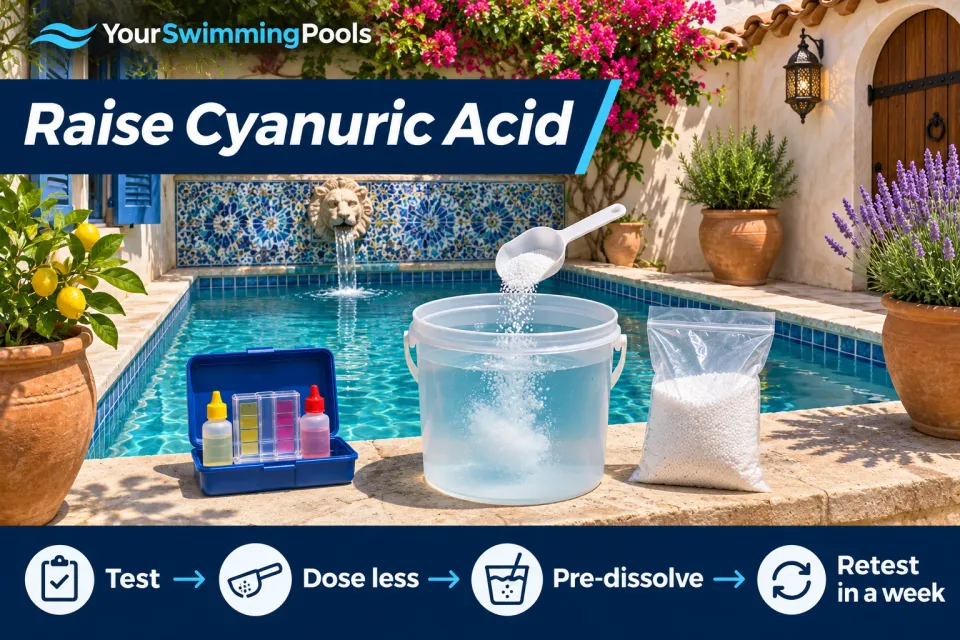
Raising stabilizer is easy. Getting it back down is not: cyanuric acid does not break down in normal use, so the practical way back is replacing water (our explanation). That is why the whole method here is built around not overshooting.
The short version: about 13.4 oz of 100% cyanuric acid raises stabilizer by 10 ppm in 10,000 gallons (our calculation). Pre-dissolve it in a bucket of water and pour it slowly around the edge with the pump running, as the Pool Solutions label says (other products: follow your own label). Then wait about a week before you test and decide on more (our advice).
Part of: Cyanuric Acid in Pools: What It Does and the Level to Aim For, our overview of stabilizer.
As an Amazon Associate we earn from qualifying purchases. We have not tested these products.
Raises stabilizer Pool stabilizer (cyanuric acid)Also sold as "conditioner". Check that the label says cyanuric acid and note the %: the dose depends on it.
How much stabilizer to add
| Pool volume | +10 ppm | +20 ppm | +30 ppm |
|---|---|---|---|
| 5,000 gal | 6.7 oz | 13.4 oz | 1.3 lb |
| 10,000 gal | 13.4 oz | 1.7 lb | 2.5 lb |
| 15,000 gal | 1.3 lb | 2.5 lb | 3.8 lb |
| 20,000 gal | 1.7 lb | 3.3 lb | 5.0 lb |
| 25,000 gal | 2.1 lb | 4.2 lb | 6.3 lb |
Our calculation for 100% cyanuric acid: ounces = gallons × 3.785 × ppm ÷ 1,000 ÷ 28.35. Granular stabilizer is close to 100% (the Pool Solutions retailer Q&A says 99%); liquid stabilizers are weaker, so use the % on your label in our pool stabilizer calculator. Not sure of your gallons? Start with the pool volume calculator.
Step by step
- Test stabilizer and decide on a target. Taylor's range is 30 to 50 ppm; TroubleFreePool aims higher for salt pools (see the ranges).
- Dose for less than the full gap. If you are at 10 ppm and aim for 40, add enough for 20 or 25 first (our advice). Under-dosing is easy to fix; over-dosing is not.
- Dissolve it the way your label says. For example, the Pool Solutions label: "Product should be added to a bucket of water and mixed. Once product has begun to pre-dissolve, slowly pour it along the perimeter of the swimming pool."
- Keep the pump running. The product page says the filter and pump should be running anytime chemicals are added; an answer in its Q&A adds: until the stabilizer is dissolved.
- Do not backwash for a few days, so undissolved granules in the filter are not thrown away (our advice).
- Test again after about a week (our advice). The reading creeps up while the last granules dissolve (our explanation).
As an Amazon Associate we earn from qualifying purchases. We have not tested these products.
For dissolving Skimmer socksMesh socks that hold slow-dissolving granules while the water passes through. Follow your stabilizer label on where to put it.
Check for hidden stabilizer first
Trichlor tablets and dichlor granules add stabilizer every time you use them (CDC). By our calculation, every 1 ppm chlorine from trichlor adds about 0.6 ppm cyanuric acid, and from dichlor about 0.9 ppm. If you chlorinate with tablets, you may not need to add stabilizer at all. See stabilized vs unstabilized chlorine.
FAQ
Is liquid stabilizer faster?
It is already dissolved, so it mixes in sooner (our explanation), but it contains less cyanuric acid per pound. Dose it by the % on its label.
My salt system manual gives a level. Which one wins?
For the cell, your manual. Hayward's AquaRite manual, for example, says to raise stabilizer to 40 ppm in outdoor pools.
Sources
- Pool Solutions Chlorine Stabilizer and Conditioner (P17025DE), product page and label directions (pre-dissolve, pour along the perimeter, pump running; 99% in its Q&A)
- Taylor Technologies: LSI calculator and target ranges (30 to 50 ppm)
- TroubleFreePool: Recommended levels (liquid and salt ranges)
- CDC: Home pool and hot tub water treatment and testing (dichlor and trichlor contain cyanuric acid)
- Hayward AquaRite owner's manual (092538 Rev D) (raise to 40 ppm)
Sources read on November 6, 2026, unless a date is given. Product labels change: the label on the product you buy always wins.
