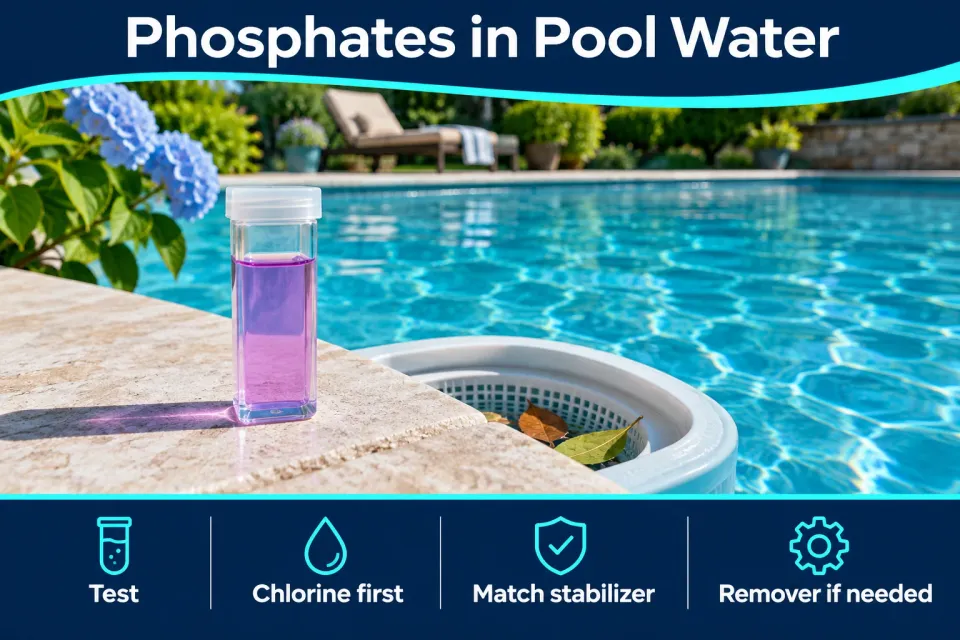
A pool store water test can include phosphates, and a high reading may be followed by a recommendation for phosphate remover. Whether you need one depends mostly on your chlorine.
The short answer: usually not, if you keep free chlorine at the minimum for your stabilizer level (our reading of TroubleFreePool). Phosphates are a nutrient for algae, but even HASA, a maker of phosphate removers, says they "do not directly reduce chlorine" and that people who say phosphates are not a concern in a balanced, chlorinated pool "are correct", although it adds that algae fed by phosphate raise chlorine demand, and that a pool party, a pH spike or high stabilizer can upset that balance. A remover can help when algae keep coming back with chlorine at the right level (our advice).
Part of: Metals, Phosphates and Other Things in Pool Water, our overview of the less common things in pool water.
Where phosphates come from
- Tap water and metal sequestrants, the two biggest sources according to HASA.
- Leaves, dirt, lawn fertilizer, rainwater runoff, swimmers' lotions and detergents (Inyo Pools).
- Sequestrants breaking down: TroubleFreePool says HEDP sequestrants turn into phosphates over time, so phosphates build up with long use.
What phosphates do, and what they do not
HASA calls phosphate "a growth limiting nutrient" for algae: more phosphate gives algae more fuel. It also says phosphates do not directly reduce chlorine, but that algae feeding on them increase chlorine demand. TroubleFreePool: high phosphate makes it "quicker and easier for algae to form if the FC goes below minimum recommended levels", which is why it stresses keeping free chlorine matched to stabilizer.
The minimum free chlorine rises with your stabilizer level: see the chart in our pool chlorine calculator and cyanuric acid in pools.
The numbers you will see
| Source | What it says |
|---|---|
| HASA (makes phosphate removers) | Keep phosphates below 500 ppb, ideally 200 ppb |
| Inyo Pools (sells pool supplies) | Below 100 ppb ideal; 100 to 250 ppb acceptable; 250 to 500 ppb take proactive measures; above 500 ppb act at once |
| TroubleFreePool | No phosphate target; keep free chlorine at the minimum for your stabilizer |
There is no phosphate number in the PHTA guideline table that Taylor publishes. The targets above come from companies that sell pool products (our note).
A test trap
TroubleFreePool: some phosphate tests read both organophosphates and orthophosphates. If you use an HEDP sequestrant, such a test can show very high readings that do not drop after a phosphate treatment. HASA: only free orthophosphates are a nutrient for algae.
When a remover can make sense
- Algae keep returning although free chlorine stays at the minimum for your stabilizer (our advice).
- You use a sequestrant for a long time and phosphates build up (TroubleFreePool). A phosphate treatment does not break down an HEDP sequestrant, according to its maker as quoted by TroubleFreePool.
- Replacing part of the water is the other option Inyo Pools mentions, if your fill water is low in phosphates (our note).
As an Amazon Associate we earn from qualifying purchases. We have not tested these products.
Optional Pool phosphate removerOnly worth a look after a test, with free chlorine already at the minimum for your stabilizer. Follow the label for the dose and for cleaning the filter.
Green water now? Chlorine first: green pool water.
Sources
- HASA: Are phosphates really a problem in swimming pools? (a maker of phosphate removers) (sources, growth-limiting nutrient, does not directly reduce chlorine, 500 / 200 ppb, orthophosphates)
- Inyo Pools: What are phosphates in pools (a pool supply retailer, 29 Oct 2025) (sources, ppb ranges, drain and refill or remover)
- TroubleFreePool: Sequestrant (sequestrants break down into phosphates, FC/CYA, test types, phosphate treatment and HEDP)
- TroubleFreePool: Free chlorine and cyanuric acid relationship (chlorine minimum by stabilizer level)
- Taylor Technologies: Technical FAQs, with the PHTA guideline table (last reviewed by Taylor 12 Aug 2026) (PHTA guideline table)
Sources read on November 6, 2026, unless a date is given. Product labels change: the label on the product you buy always wins.
