"Keep chlorine at 1 to 3", "2 to 4", "at least 3"... the numbers you hear differ. Here is where each one comes from.
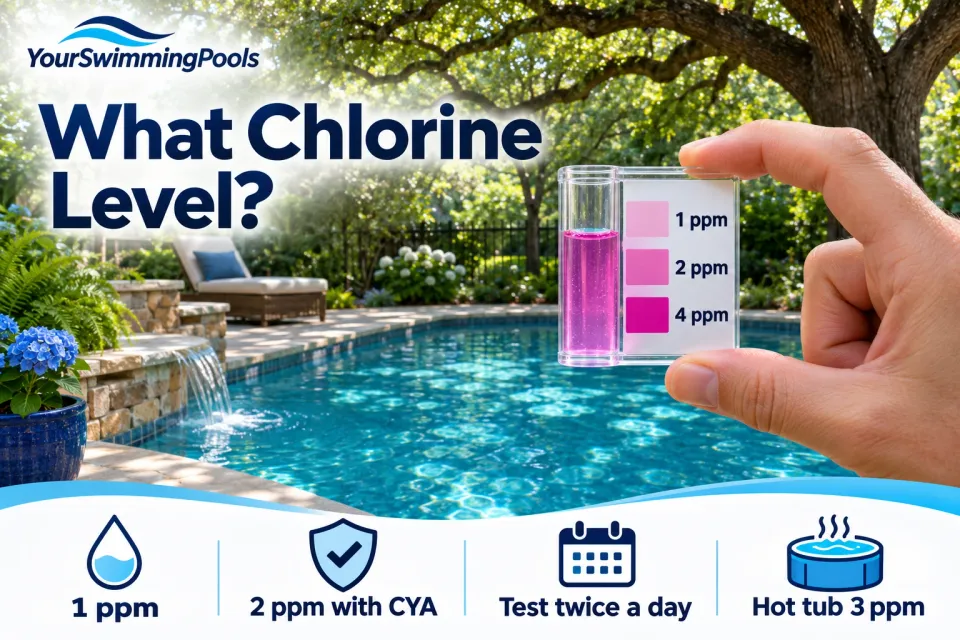
The short answer: the CDC recommends at least 1 ppm free chlorine in pools, or at least 2 ppm if you use stabilizer (cyanuric acid) or stabilized chlorine like trichlor or dichlor, with pH 7.0 to 7.8. Its consumer page calls 1 to 4 ppm the typical range. Hot tubs: at least 3 ppm.
Part of: Pool Chlorine: Types, Levels and How to Keep Them Steady, our overview of every chlorine question.
The numbers and where they come from
| Situation | Free chlorine | Source |
|---|---|---|
| Pool, no stabilizer | at least 1 ppm | CDC |
| Pool with stabilizer or trichlor/dichlor | at least 2 ppm | CDC |
| Typical range | 1 to 4 ppm | CDC consumer page |
| Hot tub | at least 3 ppm, no stabilizer | CDC |
| Doheny's tablet label | 1 to 3 ppm residual | Doheny's |
| Pool with stabilizer, by CYA level | see below | TroubleFreePool |
Why pools with stabilizer need more
The CDC says disinfection takes longer when cyanuric acid is present. TroubleFreePool explains that stabilizer holds part of the chlorine in reserve, so the higher the stabilizer, the higher the free chlorine you need. Its targets for liquid chlorine pools:
| Stabilizer (CYA) | Minimum free chlorine | Target free chlorine |
|---|---|---|
| 30 ppm | 2 ppm | 4 to 6 ppm |
| 40 ppm | 3 ppm | 5 to 7 ppm |
| 50 ppm | 4 ppm | 6 to 8 ppm |
| 60 ppm | 5 ppm | 7 to 9 ppm |
From TroubleFreePool's FC/CYA chart (liquid chlorine). Salt pools have their own, lower column. These targets are higher than the CDC minimums; the CDC numbers are the floor.
As an Amazon Associate we earn from qualifying purchases. We have not tested these products.
Test kit A test that reads stabilizer (cyanuric acid)Your chlorine target depends on your stabilizer level, so test CYA as well as chlorine.
FAQ
What chlorine level is safe to swim in?
At least the CDC minimum, and not above the re-entry level on the label of the product you used (Doheny's tablets: 3 ppm; HTH Shock Advanced product page: back at 1 to 4 ppm). See too much chlorine.
How often should I test?
The CDC: test chlorine and pH at least twice a day, more often when many people use the pool.
Sources
- CDC: Home pool and hot tub water treatment and testing (minimums, hot tubs, pH, stabilizer slows disinfection, testing twice a day)
- CDC: Guidelines for keeping your pool safe and healthy (typical range 1 to 4 ppm)
- TroubleFreePool: Free chlorine and cyanuric acid relationship (FC/CYA chart)
- Doheny's 3-inch chlorine tablets, product label and FAQ (1 to 3 ppm residual, re-entry above 3 ppm)
- HTH Pool Care Shock Advanced (read 3 Nov 2026) (swim at 1 to 4 ppm after shock)
Sources read on November 4, 2026. Product labels change: the label on the product you buy always wins.
