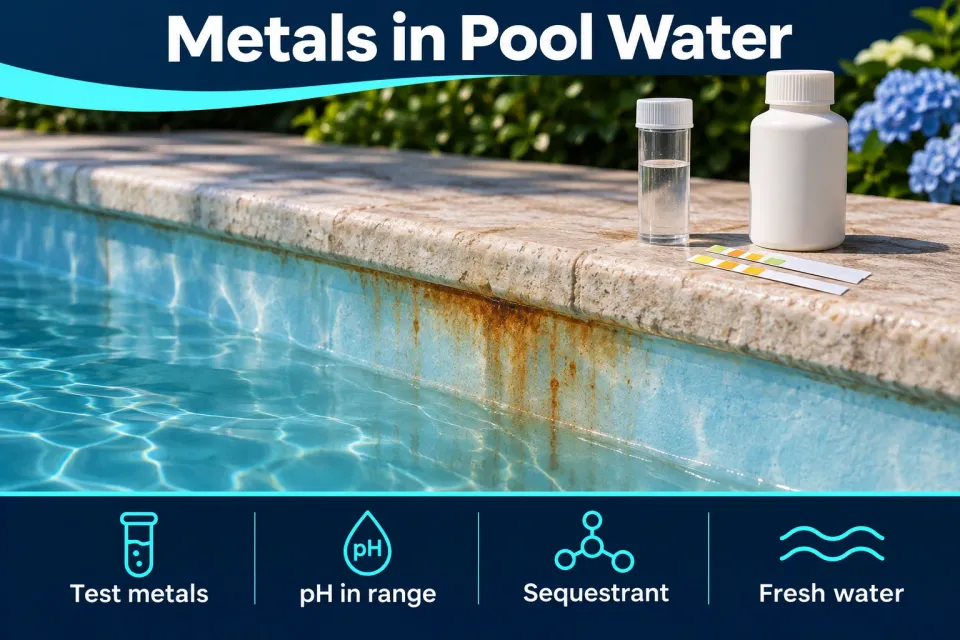
Metals in pool water are invisible until they are not: a stain that will not brush off, a test that turns purple, or blond hair with a green tint.
The short version: metals mostly come from the fill water, copper algaecides and pipes (TroubleFreePool; Taylor). Find out which metal you have, keep pH in range, and use a metal sequestrant to hold it in the water. TroubleFreePool's ascorbic acid treatment lifts iron stains but not copper stains, and it calls replacing the water with metal-free water "the best long-term solution by far".
Part of: Metals, Phosphates and Other Things in Pool Water, our overview of the less common things in pool water.
As an Amazon Associate we earn from qualifying purchases. We have not tested these products.
Test kit A test kit for copper and ironFind out which metal you have before you treat: TroubleFreePool's ascorbic acid treatment works on iron stains only.
Where the metals come from
- Fill water. TroubleFreePool: metals "usually" come from the fill water, and some well water has them.
- Copper algaecides. Copper is the active ingredient in some algaecides. One EPA-accepted copper algaecide label (2003 version) says to use a stain and scale inhibitor two days after adding it, "to tie up residual copper in pool water".
- Pipes and equipment. Taylor names "algaecides, pipes, or even the water itself" as sources of copper and iron. Water that is corrosive can attack metal parts (see corrosive pool water).
The signs
| Sign | What it can mean |
|---|---|
| A stain that does not brush off | Possibly metal. TroubleFreePool mentions that ProTeam Metal Magic has a test that tells metal stains from organic ones. |
| A purple endpoint in the calcium hardness test | Metal ions, most likely copper or iron, interfering with the test (Taylor) |
| Stains after raising pH or chlorine | TroubleFreePool: high pH and chlorine push metals that are not sequestered out of the water and onto the surface |
| A green tint on blond hair | Copper (see why pool water can turn blond hair green) |
For the calcium test, Taylor's workaround is to add five or six drops of titrant before the buffer and indicator, and to count those drops in the total.
Sequestrants: holding metals in the water
TroubleFreePool: a sequestrant binds metal ions in the water and keeps them from depositing as stains. All sequestrants break down slowly, so you add more at regular intervals. It is only needed if you have metals in your water; as general protection, TroubleFreePool only suggests it for fresh plaster, "as metal stains on brand new plaster can never be removed".
- Type: TroubleFreePool calls sequestrants based on HEDP, phosphonic acid or their derivatives the most effective.
- Chlorine: high chlorine, or a long time at raised chlorine, uses up the sequestrant, and the metals it held can come back out (TroubleFreePool, quoting the maker of one sequestrant).
- Not with a cationic clarifier: TroubleFreePool says a cationic clarifier and an anionic metal sequestrant "stick together like glue" and cloud the water, and that polymeric sequestrants are not compatible with polyquat or most clarifiers. Check both product labels before you combine them.
- Phosphates: HEDP sequestrants break down into phosphates over time (TroubleFreePool). See phosphates in pool water.
As an Amazon Associate we earn from qualifying purchases. We have not tested these products.
Holds metals Pool metal sequestrantBinds dissolved metals so they do not stain. TroubleFreePool: products based on HEDP or phosphonic acid are the most effective, and every sequestrant breaks down over time, so it needs repeat doses.
Iron stains: the ascorbic acid treatment
This is TroubleFreePool's method, in short. It works on iron stains only: "Ascorbic acid is ineffective against copper stains", which go from brown to black.
- Close the pool to swimmers for the whole treatment (our advice): free chlorine will be at or near 0. Do not reopen until free chlorine is back at the minimum for your stabilizer level and the labels of the products you used allow swimming.
- Let free chlorine drop to 0 and lower pH to 7.2. Chlorine in the water does no harm, it just uses up the ascorbic acid.
- Use about half to one pound of ascorbic acid per 10,000 gallons. Start light and see whether the stains lift before adding more.
- Set the filter to recirculate (or take the cartridges out), spread it around the edge and let it circulate for half an hour. Add more near any stain that is left.
- When the stains are gone, add sequestrant for your pool volume.
- After 24 hours, rebalance: the ascorbic acid lowers pH and sometimes alkalinity.
- Bring chlorine back up slowly, preferably with liquid chlorine, to the minimum for your stabilizer level. If stains come back, keep pH no higher than 7.2 and add more sequestrant.
- No SLAM process for at least two weeks, and keep pH around 7.2 for a week or two.
TroubleFreePool calls ascorbic acid "way milder than an acid wash", with no plaster etching. Follow the label of the products you use.
As an Amazon Associate we earn from qualifying purchases. We have not tested these products.
For iron stains Ascorbic acid (vitamin C) for poolsThe main ingredient of TroubleFreePool's iron stain treatment. On copper stains it does not work and can darken them.
The long-term fix
TroubleFreePool: "Replacing the water with metal-free water is the best long-term solution by far." It adds that draining is one of several ways to replace the water, and usually not the best one. Test your fill water for metals first (our advice): if it is the source, fresh water brings the metals back.
Before you drain: draining, even partly, can damage some pools: depending on the shell, the groundwater and other conditions, a pool can crack, shift or lift (our note). Ask your pool manufacturer or a qualified pool professional first, and check your local rules on where pool water may be discharged. The partial drain calculator gives the gallons.
Sources
- TroubleFreePool: Ascorbic acid treatment (fill water, ascorbic acid treatment, iron only, re-staining at high pH and chlorine, replacing water)
- TroubleFreePool: Sequestrant (how sequestrants work, HEDP, chlorine, clarifier, phosphates, fresh plaster, stain test)
- Taylor Technologies: Technical FAQs, with the PHTA guideline table (last reviewed by Taylor 12 Aug 2026) (sources of copper and iron, purple endpoint and workaround, heavy metals none)
- EPA-accepted label: RWP Copper Algicide (EPA Reg. 67262-24, 2003) (stain and scale inhibitor two days after a copper algaecide)
- Tomas X. et al., "Pseudo Green Hair", International Journal of Trichology, 2022 (copper and green hair)
Sources read on November 6, 2026, unless a date is given. Product labels change: the label on the product you buy always wins.
