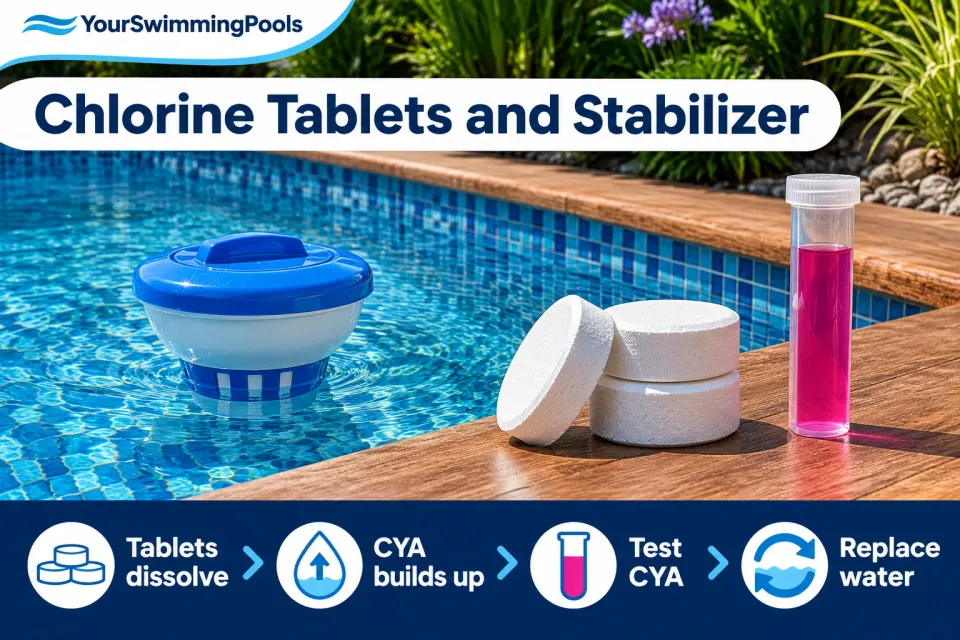
Tablets are the most convenient way to chlorinate: drop them in a floater and forget about them. The catch shows up months later.
The short version: 3-inch tablets are trichlor, a stabilized chlorine. As they dissolve they add chlorine and stabilizer (cyanuric acid, CYA) and lower pH (TroubleFreePool). Chlorine gets used up; the stabilizer does not, so it builds up. The more stabilizer, the more free chlorine you need, until the only fix is replacing water.
Part of: Pool Chlorine: Types, Levels and How to Keep Them Steady, our overview of every chlorine question.
How tablets work
Doheny's 3-inch tablets are 99% trichloro-s-triazinetrione with 90% available chlorine, compressed to dissolve slowly. The label's dose is one tablet per 10,000 gallons per week, in a feeder or stick skimmer basket, for a 1 to 3 ppm residual. Its FAQ says high water temperature, many swimmers, heavy rain or low cyanuric acid make tablets dissolve faster; cold water, poor circulation or very high cyanuric acid make them slower.
As an Amazon Associate we earn from qualifying purchases. We have not tested these products.
Slow-release chlorine 3-inch chlorine tablets (trichlor)Stabilized tablets for a floater or feeder. They add stabilizer (CYA) as they dissolve: test CYA regularly. Use the dose on the label of the product you buy.
Why stabilizer builds up
TroubleFreePool: trichlor puts chlorine and CYA into the water, and "The CYA that they put into your pool water doesn't get used up, and instead accumulates." Dichlor does the same, and can raise CYA very quickly. TroubleFreePool also notes you may see a CYA loss of 5 to 10 ppm per month, which is slow compared with what tablets add (our reading).
Why it matters
- You need more free chlorine. The CDC says disinfection takes longer with cyanuric acid present, and raises its own minimum from 1 to 2 ppm. TroubleFreePool's target free chlorine rises with every step in CYA.
- Above about 90 ppm it gets hard. TroubleFreePool: with more than about 90 ppm CYA "it becomes difficult to maintain disinfecting FC levels."
- pH drifts down. Trichlor lowers pH (TroubleFreePool); see pool pH and alkalinity.
- The only fix is water. TroubleFreePool: partial water replacement or reverse osmosis are the only reliable ways to lower CYA.
How to keep it in check
- Test CYA every few weeks while you use tablets (our advice).
- Raise free chlorine to match your CYA (chlorine level by stabilizer).
- When CYA gets high, switch to liquid chlorine, which adds no stabilizer (TroubleFreePool), and replace some water.
As an Amazon Associate we earn from qualifying purchases. We have not tested these products.
Test kit A test that reads stabilizer (cyanuric acid)Your chlorine target depends on your stabilizer level, so test CYA as well as chlorine.
Sources
- TroubleFreePool: How to chlorinate your pool (trichlor and dichlor add CYA and lower pH, CYA accumulates)
- TroubleFreePool: Free chlorine and cyanuric acid relationship (CYA above 90 ppm, CYA loss per month)
- TroubleFreePool: ABCs of pool water chemistry (lowering CYA only by water replacement or RO)
- Doheny's 3-inch chlorine tablets, product label and FAQ (tablet composition, dose, dissolving speed)
- CDC: Home pool and hot tub water treatment and testing (disinfection slower with CYA, 2 ppm minimum)
Sources read on November 4, 2026. Product labels change: the label on the product you buy always wins.
