You overdosed, or a feeder ran too long, and the chlorine test is off the chart. What now?
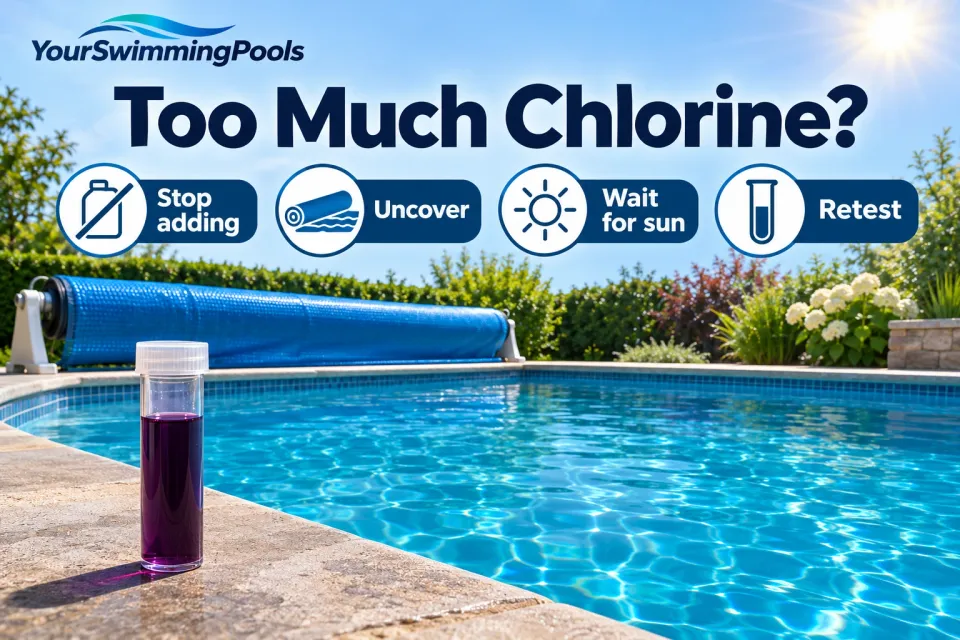
The short version: the easiest way down is to wait: sunlight and dirt in the water use up chlorine (TroubleFreePool, CDC). Uncover the pool and keep the pump running. Before swimming, follow the label of the product you used: Doheny's tablet label prohibits re-entry above 3 ppm, and HTH's Shock Advanced product page (read November 3) says to wait until free chlorine is back at 1 to 4 ppm.
Part of: Pool Chlorine: Types, Levels and How to Keep Them Steady, our overview of every chlorine question.
How high is too high?
| Source | What it says |
|---|---|
| Doheny's 3-inch tablets (label) | Re-entry prohibited above 3 ppm |
| HTH Shock Advanced (product page) | Do not swim until free chlorine is 1 to 4 ppm |
| CDC Model Aquatic Health Code (public pools) | Free chlorine above 10 ppm with bathers present is a hazard requiring closure; the upper limit for a chlorine product is set by its label |
| TroubleFreePool (pools with stabilizer) | Safe up to the SLAM level for your stabilizer level, as long as you can see the bottom |
These differ because they cover different products and pools. For a home pool, the label of the product you used is the one to follow (our advice).
Careful: a very high level can read as zero
The CDC: if chlorine is above 10 ppm, a DPD test may partially or totally bleach out, giving a false low or 0 ppm. If the sample flashes pink and then turns clear, assume the level is high and wait (our note).
How to bring it down
- Stop adding chlorine. Take tablets out of the floater or feeder, and turn a salt cell down (our advice).
- Uncover the pool and let the sun work. The CDC lists sunlight as something that reduces chlorine; TroubleFreePool: "To lower FC, simply wait; sunlight and organic matter will naturally lower FC."
- Keep the pump running so the water mixes (our advice).
- Replace some water if you need it down faster: draining part of the pool and refilling dilutes it (our note). Use the pool volume calculator to see how much water that is.
- Retest before anyone swims.
As an Amazon Associate we earn from qualifying purchases. We have not tested these products.
Test kit A test kit that reads free and total chlorineFree chlorine and total chlorine are two separate readings. The CDC calls a DPD test kit the most accurate option for home pools; test strips are less accurate. Follow the kit's own instructions.
FAQ
How long until chlorine comes down?
It depends on sun, swimmers and stabilizer. TroubleFreePool notes an average pool in summer may lose 3 to 5 ppm of free chlorine per day; test daily.
What about a chlorine neutralizer?
Chlorine neutralizers exist, but we could not find a product label to quote on dose and use, so we do not give directions here. If you use one, follow its label exactly.
Sources
- Doheny's 3-inch chlorine tablets, product label and FAQ (label: re-entry above 3 ppm)
- HTH Pool Care Shock Advanced (read 3 Nov 2026) (swim when free chlorine is 1 to 4 ppm)
- CDC: Model Aquatic Health Code, changes in the 2024 edition (public pools) (above 10 ppm with bathers, upper limit set by label)
- CDC: Home pool and hot tub water treatment and testing (test bleach-out above 10 ppm, sunlight reduces chlorine)
- TroubleFreePool: ABCs of pool water chemistry (wait for sun and organics)
- TroubleFreePool: Free chlorine and cyanuric acid relationship (safe up to SLAM level, summer loss)
Sources read on November 4, 2026. Product labels change: the label on the product you buy always wins.
