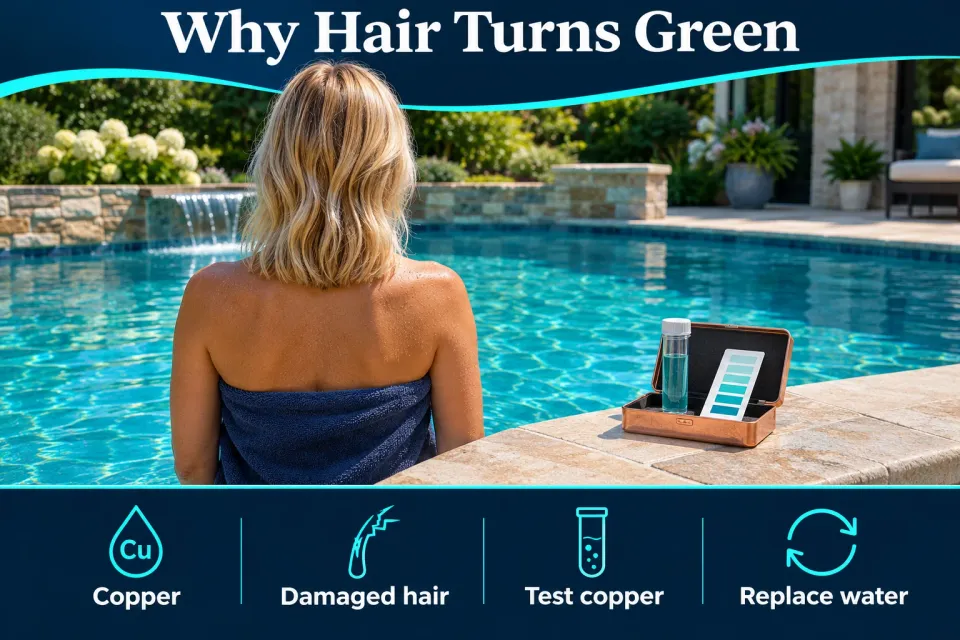
Blond hair with a green tint after a summer of swimming is usually blamed on chlorine. A 2022 medical case report points to copper first.
The short answer: copper in the water, working together with chlorine. A dermatologist quoted by the American Academy of Dermatology says chlorine "works with the copper in the water and becomes absorbed by your hair, resulting in a green hue", and that blond hair is the one to watch. A 2022 case report (International Journal of Trichology) names tap or pool water high in copper as the most frequent origin and copper algaecides as one way pool copper builds up. Its own patient is a twist, though: no copper was found in the patient's green hair, so the authors called it "pseudo green hair".
Part of: Metals, Phosphates and Other Things in Pool Water, our overview of the less common things in pool water.
Where the copper comes from
- Chlorine and copper together: the AAD dermatologist's explanation above. A copper algaecide label also says chlorinated water can discolor blonde, bleached or damaged hair, and that the algicide may further highlight it. The case report adds that "prior damage to the cuticle seems to be essential".
- Water with a lot of copper, from the tap or in the pool: "the most frequent origin", according to the case report.
- Copper algaecides added again and again. The case report links green hair to copper sulfate algaecides added repeatedly "without adequate replacement of the water".
- Pipes: Taylor names algaecides, pipes and the water itself as sources of copper and iron.
What the case report found
The pool in the report had normal pH and chlorine, but copper at 3 ppm, and its water had not been fully replaced for 7 years. In Catalonia, where it was written, copper testing is "suggested" with a level below 1.3 ppm. The twist: no copper was found in the patient's hair, so the authors called it "pseudo green hair" and suggest a reaction with the hair dye. A haircut and new coloring removed the green.
| Copper (ppm) | |
|---|---|
| The pool in the case report | 3 |
| Suggested limit in Catalonia (Spain) | below 1.3 |
| Kleen Pool Algicide label: range to keep | 0.2 to 2.0 "units" on a copper test kit (label wording) |
| PHTA guideline for heavy metals | none |
The numbers come from different rules for different purposes: the label range is for that one product, the PHTA line is a general guideline (our note).
As an Amazon Associate we earn from qualifying purchases. We have not tested these products.
Test kit A test kit for copper and ironFind out which metal you have before you treat: TroubleFreePool's ascorbic acid treatment works on iron stains only.
What to check in the pool
- Test for copper (our advice), especially if you use a copper algaecide or have copper pipes or a copper heat exchanger.
- Using a copper algaecide? Follow the label on your product (the labels we quote are EPA-accepted versions from 2011 and 2003; current labels can differ): the copper range to keep and, if the label says so, a stain and scale inhibitor afterwards (the RWP Copper Algicide label: two days after adding it).
- Too much copper: replacing the water with metal-free water is TroubleFreePool's best long-term fix (more in metals in pool water).
For swimmers
The AAD dermatologist's tips for pool hair: a swim cap, or oil or a leave-in conditioner before you swim as a barrier; rinse right after swimming, wash with a swimmers' shampoo and follow with a deep conditioner. For hair that is already green, ask a hairdresser or a dermatologist (our note).
Sources
- American Academy of Dermatology: Must-try summer hair care (last updated 31 Aug 2021) (chlorine works with copper, blond hair, swim cap, rinse, swimmers' shampoo)
- Tomas X. et al., "Pseudo Green Hair", International Journal of Trichology, 2022 (copper deposits, most frequent origin, algaecides, cuticle damage, the case: 3 ppm, 7 years, 1.3 ppm, pseudo green hair, haircut)
- EPA-accepted label: Kleen Pool Algicide (EPA Reg. 54564-2, 2011) (chlorinated water can discolor blonde, bleached or damaged hair; copper range 0.2 to 2.0; pH 7.2 to 7.6)
- EPA-accepted label: RWP Copper Algicide (EPA Reg. 67262-24, 2003) (stain and scale inhibitor two days after adding)
- Taylor Technologies: Technical FAQs, with the PHTA guideline table (last reviewed by Taylor 12 Aug 2026) (copper sources, PHTA heavy metals none)
- TroubleFreePool: Ascorbic acid treatment (replacing the water)
Sources read on November 6, 2026, unless a date is given. Product labels change: the label on the product you buy always wins.
