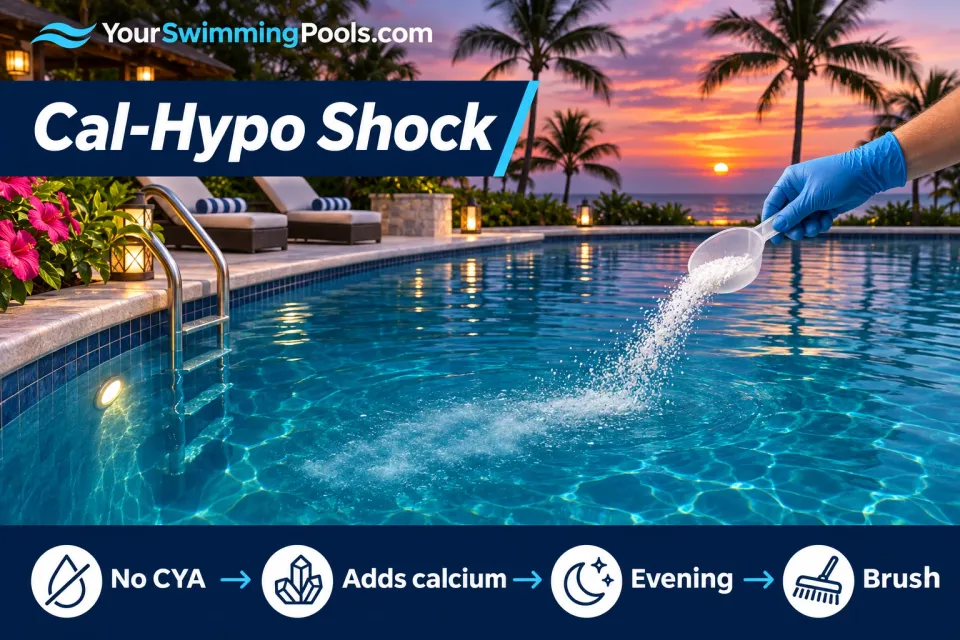
Cal-hypo is the classic bag of pool shock. Whether it is the best shock for your pool depends on two other numbers: stabilizer and calcium.
The short answer: cal-hypo adds chlorine without stabilizer (HTH) but adds calcium (TroubleFreePool; Taylor). That makes it a good choice when stabilizer is already in range or high, and a poor one when calcium hardness is already high or your fill water is hard (our reading).
Part of: Pool Shock: Types, Timing and Safety, our overview of pool shock.
What it adds
- Chlorine, without cyanuric acid (HTH: does not add stabilizer).
- Calcium. By our calculation from molecular weights, at least about 0.7 ppm calcium hardness for every 1 ppm chlorine. One weekly shock barely shows; a season of weekly shocks does.
| Your pool | Cal-hypo? |
|---|---|
| Stabilizer high (tablet pool) | Good choice: no extra stabilizer |
| Calcium low or in range, soft fill water | Good choice |
| Calcium near the top of the range, hard fill water | Prefer liquid chlorine (adds only a little salt) |
| Saltwater pool | Check your manual; see shocking a saltwater pool |
As an Amazon Associate we earn from qualifying purchases. We have not tested these products.
Unstabilized shock Calcium hypochlorite (cal-hypo) shockGranular shock without stabilizer. It adds calcium: check calcium hardness if you use it every week.
How to use it (HTH Shock Advanced label)
- Test and adjust total alkalinity and pH first.
- Add in the evening with the filter pump running, with nobody in the pool.
- Broadcast it evenly over a wide area, preferably the deepest part; do not put it in a floater or feeder.
- Brush any granules that settle: undissolved granules can bleach or damage pool surfaces.
- Swim again when free chlorine is back at 1 to 4 ppm.
If your pool has stabilizer (cyanuric acid), the low end does not apply: the CDC asks for at least 2 ppm free chlorine then, and TroubleFreePool's minimum rises with your stabilizer level (see the chart).
The label dose for that product is 1 lb per 13,500 gallons for the weekly treatment. Other products: follow their own label.
Keep an eye on calcium
If you shock with cal-hypo every week, test calcium hardness monthly and check the LSI (our advice). Ranges: calcium hardness in pools.
As an Amazon Associate we earn from qualifying purchases. We have not tested these products.
Test kit A test kit that reads calcium hardnessCalcium hardness is one of the five numbers the saturation index needs, together with pH, alkalinity, temperature and dissolved solids.
Sources
- HTH Pool Care Shock Advanced, label directions (read 3 Nov 2026) (cal-hypo, no stabilizer, directions, dose, re-entry)
- TroubleFreePool: How to chlorinate your pool (cal-hypo adds calcium)
- Taylor Technologies: LSI calculator and target ranges (calcium targets and LSI)
- CDC: Home pool and hot tub water treatment and testing (2 ppm with stabilizer)
- TroubleFreePool: Free chlorine and cyanuric acid relationship (FC minimum by CYA level)
Sources read on November 6, 2026, unless a date is given. Product labels change: the label on the product you buy always wins.
