You add chlorine, the test shows it, but the water still turns cloudy or green. Someone calls it "chlorine lock". Here is what is actually going on.
The short answer: we did not find the term "chlorine lock" on the CDC and TroubleFreePool pages we read. What people describe is usually too much stabilizer (cyanuric acid) for the amount of free chlorine. Stabilizer holds part of the chlorine in reserve, so a free chlorine reading that is fine without stabilizer can be too low with a lot of it (TroubleFreePool). The fix is more free chlorine, or less stabilizer by replacing water.
Part of: Pool Chlorine: Types, Levels and How to Keep Them Steady, our overview of every chlorine question.
What stabilizer does to chlorine
TroubleFreePool: "As CYA increases, it binds a larger share of free chlorine into a reserve form, which lowers the active chlorine level at any given FC." The CDC says the same in its own way: disinfection times are longer when cyanuric acid is present, and its minimum rises from 1 to 2 ppm.
So the chlorine is not "locked"; it is held back, and the free chlorine target has to rise with the stabilizer (our explanation of these sources).
Signs it is happening to you
- You use tablets or dichlor (both add stabilizer, TroubleFreePool) and have not tested CYA in a while.
- Free chlorine is at a "normal" 2 to 3 ppm but algae or cloudiness keep coming back.
- Stabilizer above about 90 ppm: TroubleFreePool says it becomes difficult to maintain disinfecting free chlorine levels.
The fix
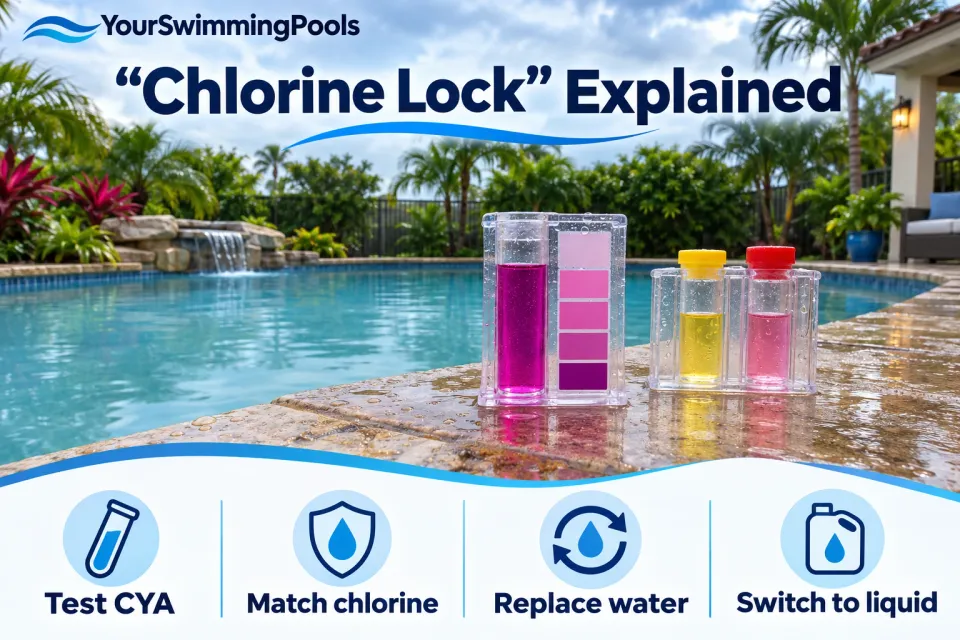
- Test stabilizer (CYA).
- Raise free chlorine to the target for that CYA level (the FC/CYA table).
- If CYA is very high, replace part of the water: TroubleFreePool calls partial water replacement or reverse osmosis the only reliable fix.
- Switch from tablets to liquid chlorine so CYA stops rising (chlorine tablets and stabilizer).
As an Amazon Associate we earn from qualifying purchases. We have not tested these products.
Test kit A test that reads stabilizer (cyanuric acid)Your chlorine target depends on your stabilizer level, so test CYA as well as chlorine.
Sources
- TroubleFreePool: Free chlorine and cyanuric acid relationship (CYA holds chlorine in reserve, above 90 ppm)
- TroubleFreePool: How to chlorinate your pool (tablets and dichlor add CYA)
- TroubleFreePool: ABCs of pool water chemistry (lowering CYA)
- CDC: Home pool and hot tub water treatment and testing (disinfection slower with CYA, 2 ppm minimum)
Sources read on November 4, 2026. Product labels change: the label on the product you buy always wins.
