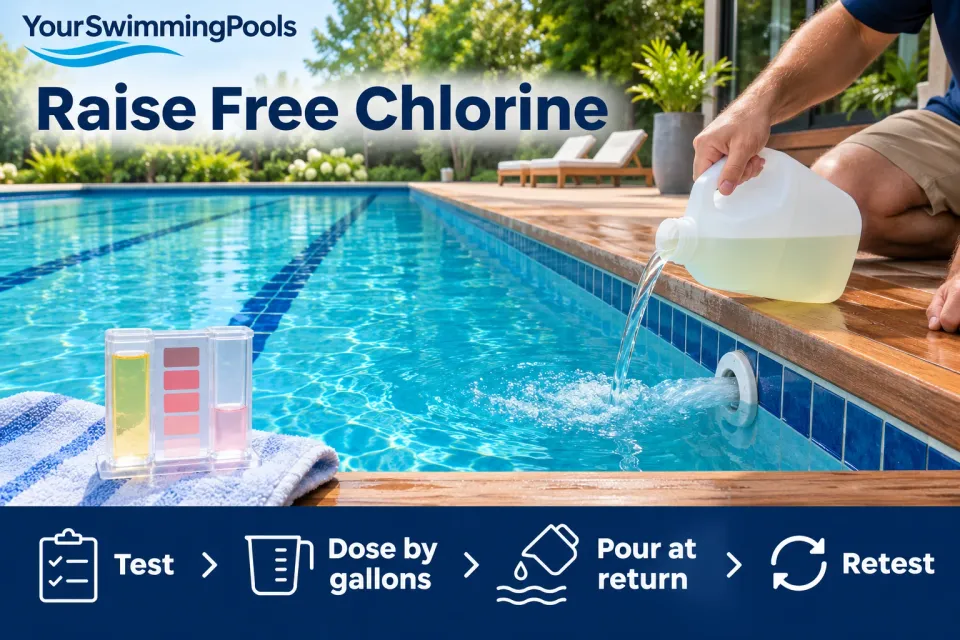
Your free chlorine test reads low, or zero. Here is how much chlorine to add, how to add it, and how to find out why it dropped.
The short version: the CDC minimum is 1 ppm free chlorine, or 2 ppm with stabilizer. Liquid chlorine is the simplest way to raise it: about 10 fl oz of 12.5% liquid chlorine raises a 10,000-gallon pool by about 1 ppm (our arithmetic). Add it with the pump running and retest. If it keeps dropping, sunlight, low stabilizer or something in the water is using it up.
Part of: Pool Chlorine: Types, Levels and How to Keep Them Steady, our overview of every chlorine question.
What to aim for
Stay above the CDC minimum: 1 ppm free chlorine, or 2 ppm if you use stabilizer or stabilized chlorine. With stabilizer, TroubleFreePool's view is that the right free chlorine level rises with the stabilizer level (for example 4 to 6 ppm at 30 ppm stabilizer with liquid chlorine). Details: what chlorine level should a pool have?
How much liquid chlorine?
| Pool volume | 6% (household bleach strength) | 10% | 12.5% |
|---|---|---|---|
| 5,000 gal | 10.7 fl oz | 6.4 fl oz | 5.1 fl oz |
| 10,000 gal | 21.3 fl oz | 12.8 fl oz | 10.2 fl oz |
| 15,000 gal | 32.0 fl oz | 19.2 fl oz | 15.4 fl oz |
| 20,000 gal | 42.7 fl oz | 25.6 fl oz | 20.5 fl oz |
| 25,000 gal | 53.3 fl oz | 32.0 fl oz | 25.6 fl oz |
Liquid chlorine to raise free chlorine by 1 ppm. Our arithmetic: milliliters = gallons × 3.785 ÷ (strength % × 10), the same formula as our pool chlorine calculator. For 3 ppm, multiply by 3. It matches TroubleFreePool's rule that 2 cups of 3% chlorine raise free chlorine as much as 1 cup of 6%.
Granules or tablets have their own doses: use the pool chlorine calculator or the product label.
Step by step
- Test free chlorine and pH. The CDC says chlorine works less well as pH rises, especially above 8.0.
- Work out the dose for your volume and the strength on your bottle (table above). Not sure of the gallons? Pool volume calculator.
- Make sure nobody is in the pool and run the pump.
- Pour liquid chlorine slowly in front of a return jet. TroubleFreePool: "in a pencil thin stream, in front of a return jet".
- Let it circulate, then retest before adding more.
As an Amazon Associate we earn from qualifying purchases. We have not tested these products.
Raises free chlorine Liquid chlorine (sodium hypochlorite)Sold as "liquid chlorine" or "chlorinating liquid". Check the strength (%) on the label: the dose depends on it. Shipping rules differ by product and state.
Why free chlorine drops
- Swimmers and dirt: the CDC lists pee, poop, sweat and dirt as things that reduce chlorine.
- Sunlight: also on the CDC's list. TroubleFreePool: in summer an average pool may lose 3 to 5 ppm of free chlorine per day.
- Too little stabilizer in an outdoor pool: Doheny's tablet label says to add stabilizer to reduce the effect of sunlight on the chlorine; see the stabilizer calculator.
- Something in the water using it up: TroubleFreePool's overnight test: test free chlorine after sunset and before sunrise; losing more than 1 ppm overnight means something in the water needs to be removed. See how to shock a pool.
As an Amazon Associate we earn from qualifying purchases. We have not tested these products.
Test kit A test kit that reads free and total chlorineFree chlorine and total chlorine are two separate readings. The CDC calls a DPD test kit the most accurate option for home pools; test strips are less accurate. Follow the kit's own instructions.
FAQ
My test shows 0 ppm. Is it really zero?
Possibly not. The CDC warns that above 10 ppm a DPD test can bleach out and show a false low or 0 ppm. If you just added a lot of chlorine, dilute the sample with distilled water and retest (our suggestion), or wait and retest.
Can I swim with low chlorine?
The CDC's minimum is 1 ppm (2 ppm with stabilizer). Below that, we would raise it before anyone swims (our advice).
Sources
- CDC: Home pool and hot tub water treatment and testing (minimums, pH, what reduces chlorine, test bleach-out above 10 ppm)
- TroubleFreePool: Free chlorine and cyanuric acid relationship (free chlorine by stabilizer level, summer loss)
- TroubleFreePool: Recommended pool chemicals (how to add liquid chlorine, 3% vs 6% rule)
- TroubleFreePool: Overnight FC loss test (overnight chlorine loss test)
- Doheny's 3-inch chlorine tablets, product label and FAQ (stabilizer reduces the effect of sunlight)
Sources read on November 4, 2026. Product labels change: the label on the product you buy always wins.
