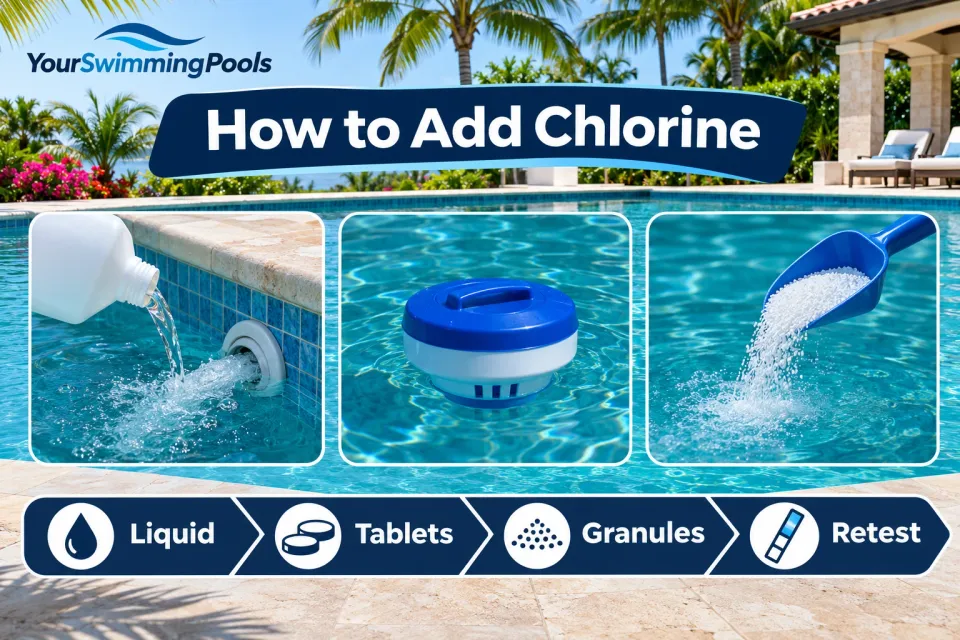
Each type of chlorine goes into the pool a different way. Get it wrong and you bleach a liner or damage a heater; get it right and it is a two-minute job.
The short version: pour liquid chlorine slowly in front of a return jet with the pump running (TroubleFreePool). Put tablets in a floater or feeder, not loose on the pool floor; Doheny's label FAQ warns against the skimmer in vinyl-liner pools and pools with a heater. Add granules as their label says. Always test first and after.
Part of: Pool Chlorine: Types, Levels and How to Keep Them Steady, our overview of every chlorine question.
Before you add any chlorine
- Test free chlorine and pH; balance pH first (pool pH and alkalinity).
- Know your volume (pool volume calculator) and work out the dose (pool chlorine calculator).
- Nobody in the pool, pump running (our advice; product labels say the same for their own products).
- Never mix chlorine products with each other or with acid (our advice; the CDC's pool chemical safety page, written for pool operators, says to store each pool chemical separately and keep incompatible chemicals away from each other).
Liquid chlorine
TroubleFreePool: pour it "in a pencil thin stream, in front of a return jet". About 10 fl oz of 12.5% liquid chlorine raises 10,000 gallons by about 1 ppm (our arithmetic; table in how to raise free chlorine).
As an Amazon Associate we earn from qualifying purchases. We have not tested these products.
Raises free chlorine Liquid chlorine (sodium hypochlorite)Sold as "liquid chlorine" or "chlorinating liquid". Check the strength (%) on the label: the dose depends on it. Shipping rules differ by product and state.
Tablets (trichlor)
Doheny's 3-inch tablet label: with the pump running, one 3-inch tablet per 10,000 gallons every week, in a suitable feeder or a stick skimmer basket, until a 1 to 3 ppm residual is reached. Its FAQ adds: do not place tablets on the pool surface or in the skimmer if your pool has a vinyl liner, and not in the skimmer basket if your pool has a heater; a floating dispenser or automatic chlorinator is generally safer for equipment.
As an Amazon Associate we earn from qualifying purchases. We have not tested these products.
For tablets Floating chlorine dispenserKeeps tablets out of the skimmer and off the pool surface, as tablet labels advise for vinyl-liner pools and pools with a heater.
Granules (dichlor or cal-hypo)
Follow the label of your product: it gives the dose and whether to broadcast or pre-dissolve. Keep in mind what each adds: dichlor adds stabilizer, cal-hypo adds calcium (TroubleFreePool). For shocking with granules, see how to shock a pool.
As an Amazon Associate we earn from qualifying purchases. We have not tested these products.
Test kit A test kit that reads free and total chlorineFree chlorine and total chlorine are two separate readings. The CDC calls a DPD test kit the most accurate option for home pools; test strips are less accurate. Follow the kit's own instructions.
FAQ
Can I put chlorine tablets in the skimmer?
Doheny's label allows a stick skimmer basket, but its own FAQ warns against it for vinyl-liner pools and pools with a heater, because highly chlorinated water can sit in the plumbing when the pump is off. A floater or feeder avoids that.
When is the best time to add chlorine?
The CDC lists sunlight as something that reduces chlorine, so adding it in the evening gives it longer to work (our suggestion).
Sources
- TroubleFreePool: Recommended pool chemicals (how to pour liquid chlorine)
- Doheny's 3-inch chlorine tablets, product label and FAQ (tablet dose, placement, vinyl and heater warnings)
- TroubleFreePool: How to chlorinate your pool (what each chlorine type adds)
- CDC: Home pool and hot tub water treatment and testing (sunlight reduces chlorine)
- CDC: Guidelines for keeping your pool safe and healthy (follow product labels)
- CDC: Pool chemical safety (written for pool operators) (store chemicals separately)
Sources read on November 4, 2026. Product labels change: the label on the product you buy always wins.
