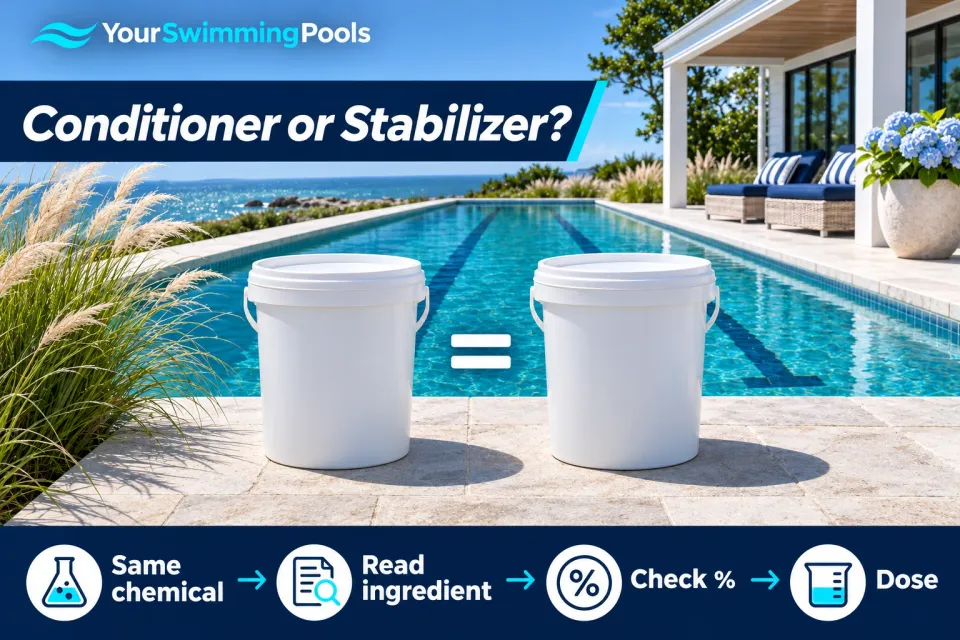
One store sells "stabilizer", the next "conditioner", and some buckets say both. If you are wondering whether you need two products: you do not.
The short answer: usually yes. Both names are used for cyanuric acid. The product we checked is called "Chlorine Stabilizer and Conditioner" and lists "Stabilizer (Cyanuric Acid)"; its retailer Q&A says 99% cyanuric acid. Read the ingredient, not the name.
Part of: Cyanuric Acid in Pools: What It Does and the Level to Aim For, our overview of stabilizer.
What to look for on the label
- The ingredient: cyanuric acid. For the Pool Solutions product, the Q&A on the retailer's product page says 99% cyanuric acid, 1% other ingredients.
- The percentage: the 99% above is for that one product. Granular products are usually close to 100% and liquid stabilizers are weaker (our note), but your own label is what counts. The dose in our stabilizer calculator depends on it.
- The directions: how to dissolve it and when to retest.
Do you need it at all?
Not if you use trichlor tablets or dichlor: the CDC notes these chlorine products already contain cyanuric acid. And not in a hot tub: the CDC recommends not using cyanuric acid there (why).
As an Amazon Associate we earn from qualifying purchases. We have not tested these products.
Raises stabilizer Pool stabilizer (cyanuric acid)Also sold as "conditioner". Check that the label says cyanuric acid and note the %: the dose depends on it.
Sources
- Pool Solutions Chlorine Stabilizer and Conditioner (P17025DE), product page and label directions (product name, "conditioner", 99% in its Q&A)
- CDC: Home pool and hot tub water treatment and testing (dichlor and trichlor contain cyanuric acid; hot tubs)
Sources read on November 6, 2026, unless a date is given. Product labels change: the label on the product you buy always wins.
